The Starting Point Is Not What an Animal Can Teach a Child
When children meet an animal, learning will happen.
They will notice how it moves. They will ask what it eats. They may learn to slow their body, use a quieter voice, wait, observe and respond to signs of comfort or discomfort.
They may develop empathy, responsibility, patience and a stronger understanding of living systems.
All of that matters.
But at Eco Patch, it is not where the story begins.
We do not believe an animal needs to justify its presence by what it can teach a child.
The animal has needs, limits, preferences and value of its own.
That distinction changes the relationship.
Instead of asking, “What can children get from this animal?”, we start with a different question:
“What responsibility do we have towards another living being?”
The learning comes from children being invited into that real responsibility.
The animal is not there for the purpose of creating the lesson.
Care Is Not a Transaction
Children grow up in a world where usefulness is often treated as a measure of value.
We use things while they serve a purpose. We replace them when they no longer do. We are rewarded for results, productivity and performance.
Living things should not be understood that way.
One of the ideas Eco Patch wants children to experience, not simply hear adults explain, is that care does not depend on what we receive in return.
We do not only care for another life while it is useful to us.
We do not only care when it is entertaining, productive, convenient or able to give us something.
Care can also mean giving back.
It can mean responsibility without reward.
It can mean recognising that another life matters because it is a life.
Visiting Animals: Receiving an Experience and Contributing Back
Eco Patch has been speaking directly with Aussie Farm Animals about visiting animal experiences.
An important part of that conversation was understanding what sits behind the visit itself.
Many of the animals in their care come through rescue circumstances. They are cared for while suitable new homes are found, and the organisation is part of the local community.
That changes how we think about paying for an animal visit.
We do not see it simply as purchasing an “experience” for children.
The payment also contributes to the ongoing care of animals while they are being looked after and, where appropriate, rehomed.
So the relationship is not one-directional.
Children may receive the joy and curiosity of meeting an animal, but the Eco Patch community is also contributing something back to the animals and people caring for them.
That matters to us.
It allows the experience to sit inside a wider idea of reciprocity rather than consumption.
The question is not only, “What did the children get from today?”
It can also be, “What did we contribute?”
Future Resident Animals: Care After Usefulness
This philosophy becomes even clearer when we think about possible future resident animals.
One idea Eco Patch is exploring is adopting retired hens, potentially through Collingwood Children’s Farm, and providing them with a home for the rest of their lives.
A retired hen may no longer lay many eggs. In conventional terms, she may no longer be considered “productive”.
But she has already given.
And even if she had not, she would still deserve appropriate care, safety and dignity.
Imagine what children can experience when they help care for an animal that is not there to perform for them.
There is no promise of eggs.
No expectation that the animal must entertain.
No requirement that it earn its place.
The responsibility remains because the life remains.
That is a very different lesson from a poster that says “be kind to animals”.
It is care made visible through routine.
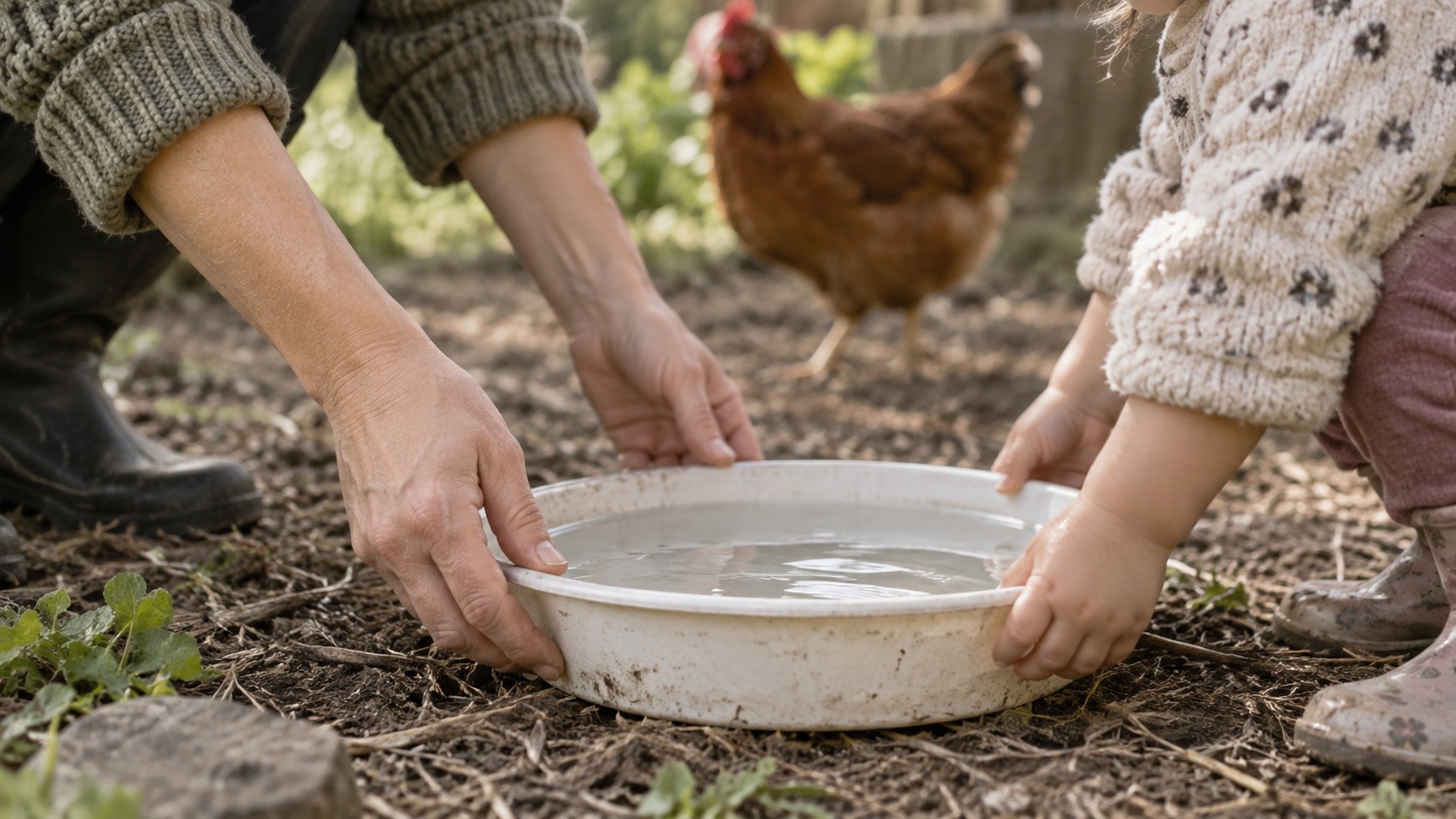
Water still needs to be checked.
Food still needs to be provided.
The environment still needs to be maintained.
The animal’s behaviour still needs to be observed and respected.
Its boundaries still matter.
And children can begin to understand that responsibility is not something we practise only while it is convenient.
What Children Learn Because the Responsibility Is Real
This is where the developmental learning appears.
Not because we placed an animal into the environment as a teaching device, but because genuine care asks something of the child.
A child may have to wait when they want to move closer.
They may have to accept that an animal does not want to be touched.
They may have to remember a routine that matters even when they would rather be doing something else.
They may notice that water is low, that behaviour has changed or that an animal needs quiet.
They begin to encounter an important truth:
Another living being can have needs that are different from mine, and those needs still matter.
That is empathy in a much more practical form.
It is not simply naming a feeling.
It is changing your own behaviour because you have noticed another life.
The Animal’s “No” Matters
One of the simplest ways adults can model this philosophy is to treat an animal’s boundaries as meaningful.
If an animal moves away, hides, freezes, becomes unsettled or shows signs that it needs space, that information should matter.
The child’s desire to touch does not override the animal’s need to feel safe.
That is not a lost learning opportunity.
That is the learning opportunity.
Children can begin to understand that affection, curiosity and good intentions do not give us automatic access to another living being.
Respect sometimes means stepping back.
Sometimes it means watching instead of touching.
Sometimes it means accepting “not now”.
Those are deeply human ideas too.
The Role of Educators
Educators are essential in making sure these relationships remain respectful, safe and meaningful.
Their role is not to manufacture a lesson from every encounter.
It is to help children notice what is actually happening.
“What do you see?”
“What might it need?”
“How can we tell?”
“What should we do if it moves away?”
“What is our job today?”
Over time, children can move from excitement towards attentiveness.
From “Can I touch it?” towards “Is it comfortable?”
From “What can it do?” towards “What does it need?”
From receiving an experience towards participating in care.
What This Means at Eco Patch Pakenham
Eco Patch Pakenham plans to include relationships with living things in ways that are appropriate, safe and grounded in welfare.
Early plans include visiting animals, fish within the centre and an onsite insect library. Future resident animals and partnerships will only proceed when they can be supported responsibly and their welfare can be properly maintained.
The principle underneath all of them is the same.
Animals are not decorations.
They are not curriculum props.
They are not there to perform kindness back to us.
They are living beings towards whom we have responsibilities.
Children will naturally learn through participating in that responsibility.
They may become more observant.
More patient.
More capable of noticing another perspective.
More willing to take responsibility for actions that affect something beyond themselves.
But those outcomes are the consequence of real care.
They are not the reason the animal has value.
The Kind of Care We Want Children to Know
There is a simple idea underneath all of this:
We do not only care for another life while it is useful to us, or because we expect something in return.
Care also means giving back, taking responsibility and recognising the value of another life in its own right.
A young child does not need those words memorised.
They need opportunities to live the idea.
To fill the water because it needs filling.
To wait because another life needs space.
To contribute to the care of animals they may only meet once.
To care for an older animal even when it no longer produces anything for them.
To discover that responsibility is not always about what we get.
Sometimes it is about what we are willing to give.
That is the animal philosophy Eco Patch wants to build from.
And the learning follows from there.
References
ACECQA, guidance on pets and animals in education and care services
Australian Government, Early Years Learning Framework
Eco Patch discussions with Aussie Farm Animals regarding its rescue, care and rehoming model