
A Beautiful Playground Is Not the Point
Families often notice outdoor spaces first because they are easy to see.
Gardens. Timber. Paths. Climbing areas. Natural materials. Shade. Water. Open space.
But Eco Patch is not investing in nature because it photographs well.
The more important question is:
What does this environment ask a child to do, notice, practise and return to over time?
A thoughtfully designed space can invite movement, collaboration, investigation, risk judgement, quiet regulation, creativity and problem solving.
But nature adds something else.
It introduces realities the child cannot completely control.
Nature Does Not Follow the Child’s Timetable
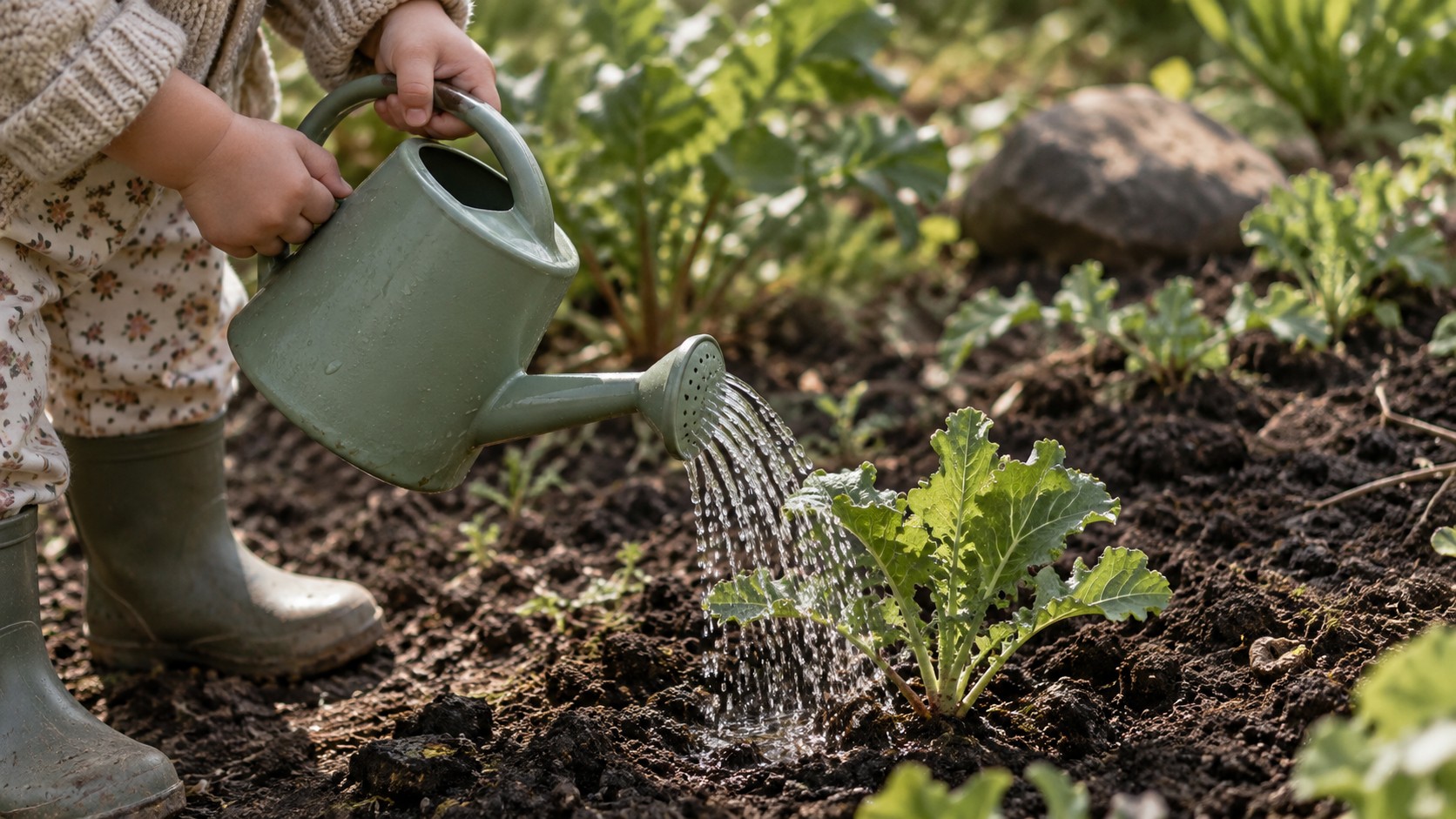
A child can water a plant every day and still has to wait.
They can care for a garden and discover that weather changes the outcome.
A seed may thrive. Another may struggle. A branch may break. Leaves fall. Seasons shift. Soil dries out. Something may not work despite genuine effort.
That matters developmentally.
Children need experiences where effort is important but does not guarantee immediate control.
They need chances to wait, notice, adapt, feel disappointed, try again and discover that care can continue even when the result is uncertain.
That is one reason nature can contribute to self-regulation in a way a completely controlled activity cannot.
The lesson is not “plants teach patience”.
The experience itself asks patience of the child.
Care becomes something they have to return to.
Routine Turns an Activity Into Development
Watering a garden once is an activity.
Returning to it day after day is different.
A child has to remember what needs doing.
They begin to notice what changed since yesterday.
They may have to keep caring before they can see a result.
They learn that some things develop slowly.
They see that forgetting has consequences and that consistency matters.
The developmental value is in the repetition.
Responsibility becomes real because the task exists whether the child feels excited about it that day or not.
Patience is practised because growth cannot be rushed.
Observation deepens because change is gradual.
Self-regulation is supported because children encounter waiting, uncertainty, disappointment and the need to continue.
This is more meaningful than adding a garden and calling it a nature program.
The Environment Still Needs to Be Intentionally Designed
Nature does not mean leaving everything to chance.
Eco Patch’s approach is intentional.
Movement spaces should give children different ways to run, balance, climb, carry, stop, change direction and judge risk.
Loose materials should invite children to plan, build, test, collaborate and change an idea.
Water can create opportunities for prediction, measurement and cause and effect.
Gardens can create long-term routines of care, observation and responsibility.
Quiet spaces can give children somewhere to regulate before returning to the group.
Uneven and varied surfaces can ask more of balance, body awareness and judgement than a flat, predictable surface.
The point is not to collect more features.
Every part of the environment should have a developmental reason for being there.
A good space should offer different children different ways to participate.
One child may immediately climb.
Another may watch for three mornings before trying.
One child may see a log as something to balance on.
Another may turn it into part of a construction.
The environment should leave room for both.
The Educator Makes the Environment More Powerful
A thoughtfully designed space does not replace an educator.
The educator notices when repetition has become investigation.
They bring language to what the child is discovering without taking over.
They may ask what changed, what the child predicts, what another solution could be or what needs to happen next.
They help children return to yesterday’s idea.
They help make care routines visible.
They support appropriate risk rather than removing every challenge.
And they know when not to interrupt.
Sometimes deeper learning needs a question.
Sometimes it needs time.
Why Long-Term Commitment Changes What You Build
Eco Patch Pakenham is being designed and built around how Eco Patch intends to operate it for the long term.
That matters.
The point is not ownership for ownership’s sake.
The point is what long-term commitment allows us to do differently.
When you are building an environment to operate over time, you can justify investing in landscaping, planting, natural materials, movement spaces and environments that are intended to mature rather than simply look finished on opening day.
A tree can be planted knowing children will experience it at different stages of growth.
A garden can become part of an ongoing rhythm rather than a decorative add-on.
Natural environments can be designed into the centre from the beginning rather than added later as a theme.
That long-term mindset changes the question from:
“What do we need to make this space look complete?”
to:
“What kind of environment do we want children to grow alongside?”
Nature Is Not a Collection of Features
A nature-rich environment is not defined by the number of plants, timber elements or garden beds it contains.
The deeper story is what children repeatedly experience through it.
They experience movement.
They experience waiting.
They experience care.
They experience uncertainty.
They experience things changing without asking permission.
They experience ideas that fail and need to be adapted.
They experience responsibility that has to be revisited.
They experience collaboration because some problems are easier to solve together.
They experience moments when they need to regulate themselves before returning to the task.
Nature gives children opportunities, but it also gives them realities.
That combination matters.
What Parents Can Look For
When you tour an early learning environment, look beyond how polished it appears.
Ask what children are expected to do there.
Can they revisit ideas over several days?
Are there responsibilities that exist beyond a one-off activity?
Are there spaces for vigorous movement and spaces for regulation?
Can children investigate, alter, combine and test materials?
Does the environment change with seasons and use, or is it mostly static?
Can educators explain why particular spaces exist and what children practise through them?
A strong environment should have answers beyond “the children love it”.
The Environment Eco Patch Is Building
At Eco Patch Pakenham, the environment is intended to be part of the curriculum, not simply the setting around it.
Playground-to-Plate can connect growing, caring, harvesting and food.
Movement spaces can build repeated experience with balance, running, climbing, carrying, stopping and changing direction.
Natural materials and loose parts can create problems without one correct solution.
Gardens can ask children to return, wait, remember, notice and adapt.
Quiet spaces can support regulation.
Animal and insect experiences can deepen ideas of care, responsibility and living systems.
Each of these matters because of what children repeatedly do through them.
That is the distinction Eco Patch wants families to understand.
Nature is not decoration added after the important learning has been planned.
It is part of how the important learning happens.
What Parents Can Look For
Children do not learn patience because an adult tells them to be patient.
They learn it through experiences that require waiting.
They do not learn responsibility because we put the word on a wall.
They learn it because something real needs their care again tomorrow.
They do not learn adaptability because everything works the first time.
They learn it because plans fail, weather changes, materials behave differently and they have to decide what to do next.
That is why Eco Patch has chosen to invest so heavily in nature and environment.
Not to create the most impressive playground.
To create an environment that keeps giving children something meaningful to respond to.
And because Eco Patch is building with a long-term operating commitment, that environment can be designed to mature with the children rather than simply be installed for them.
That is the difference we want families to see.
References
ACECQA, guidance on physical environments and the environment as a contributor to learning
Australian Government, Early Years Learning Framework