
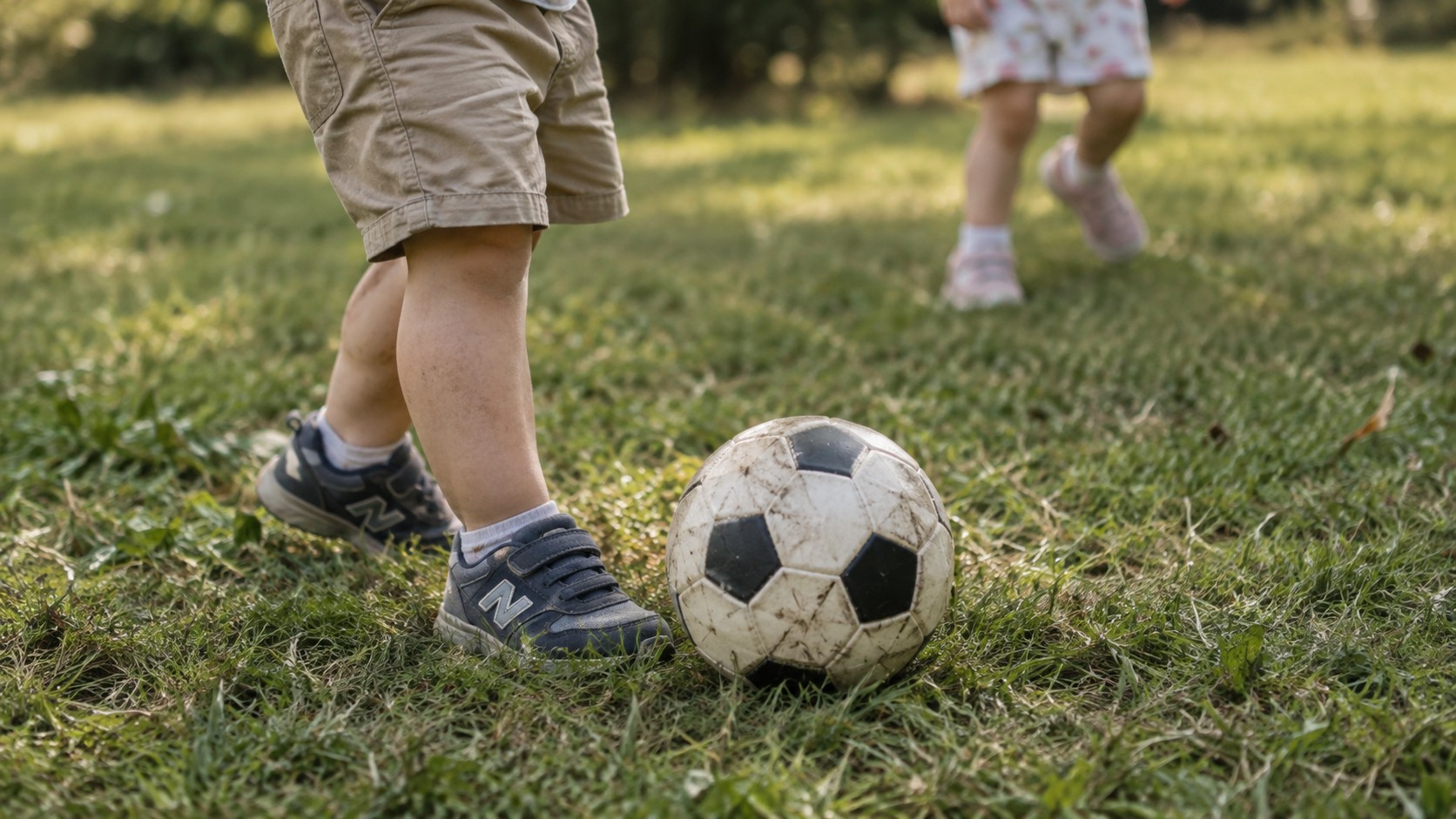
The Gap Before the Game
Australian guidelines recommend that toddlers and preschoolers are active for at least three hours across the day, with preschoolers including at least one hour of energetic play. But being active is not the same as practising every movement a child may later need for games and sport.1
That is important, but it is not the whole story.
Even when children are active, they may not always be practising the specific movements that sport later asks them to use. Running around the playground is one kind of movement. Catching a ball that is coming towards you is another. Throwing overarm with control is another. So are kicking, striking, hopping, balancing, stopping and changing direction.
These skills do not always develop just because a child has energy. Some movements happen naturally. Others need more chances, more space and more repetition.
That is what an Australian preschool study helps us understand. In a study of 425 preschool children in Sydney, researchers looked at skills such as running, hopping, catching, kicking, striking and overhand throwing. Almost 75% of children had mastered running, which makes sense, because running is repeated again and again in ordinary life.2
But the skills that need more deliberate practice were much lower: only around 20% had mastered catching, around 16% had mastered overhand throwing, around 14% had mastered striking, and even hopping was mastered by only around 25% of children.2
This does not mean children are failing. It means many children have not yet had enough repeated chances to build the movement skills that sport will later depend on.
So when a child hesitates as the ball comes near, it may not mean he is shy. It may not mean he is “not sporty”. It may simply mean the movement has not become familiar enough yet.
The question is not only: Will sport build his confidence?
The better question is: What does he need to practise before sport can do that job well?
The Skill Gap That Becomes a Confidence Gap
This is where the research becomes useful for parents.
The Australian preschool study used a recognised assessment called the Test of Gross Motor Development–Second Edition, often shortened to TGMD-2. That sounds technical, but the idea is simple: it looks at the basic movement patterns children need before sport becomes sport.2
Some are locomotor skills , how a child moves their own body through space, such as running, hopping, galloping and jumping.
Others are object-control skills , how a child uses their body to control or respond to something else, usually a ball, such as catching, kicking, striking and throwing.
That difference matters. A child may run, climb, chase and jump every day, but still not have had enough practice watching a ball come towards him, reaching for it, throwing it back, kicking with direction, or striking with timing.
And once sport begins, those skills suddenly become very important. They can be the difference between standing near the game and knowing how to enter it.
That is why these early movement skills can tell us something about later participation. Not because one missed catch predicts a child’s future, but because children tend to return to activities where their body feels capable. They are more likely to step away from activities where they repeatedly feel lost, rushed or behind.
The same Australian study notes that children who do not master these fundamental movement skills are more likely to experience difficulty in movement situations and less likely to take part in sport and games as they grow older.2
Other Australian research found a similar pattern later on: children who were more proficient in object-control skills, such as throwing, catching and kicking, had up to a 20% higher chance of taking part in vigorous physical activity as adolescents.3
So this is not about turning every child into an athlete. It is about giving your child enough movement foundation to enter sport with a fair chance of enjoying it.
Because confidence is much easier to build when the body has already had enough practice to know:
I can have a go here.
What You Can Do at Home Now
The good news is that you do not need to coach more, correct more, or add another pressure to family life.
For young children, the best support is usually simple: small, playful, repeated movement experiences. Not a training session. Not a performance. Not another thing to get perfect. NSW Health’s Munch & Move program also encourages play-based activities to help children build fundamental movement skills.4
Just ordinary chances for your child’s body to meet these movements often enough that they start to feel familiar.
1. Repeat simple skills often, not perfectly
Catching, throwing, kicking, hopping and striking improve through regular practice. But regular practice does not need to look serious. It might be five minutes in the backyard, a few throws before dinner, or a quick hopping game on the way to the car.4
The aim is not perfection. The aim is to let your child meet the same movement again and again, until it starts to feel familiar.
2. Make it playful, not instructional
A balloon can become a striking game. A rolled-up pair of socks can become a catching game. A laundry basket can become a throwing target. A chalk line can become a hopping challenge.
When it feels like play, children are more willing to try, miss, laugh and try again. That matters, because children usually need many repetitions before a movement starts to feel natural.4
3. Use everyday home moments
You can think about movement in three simple groups: balance skills, movement skills like running, jumping and hopping, and ball skills like catching, throwing, kicking, rolling and striking.5
That means you can build practice into ordinary moments. Hop to the bathroom. Balance along the edge of a rug. Roll a ball down the hallway. Kick a soft ball to the back fence. Throw socks into the washing basket.
Small moments count when they happen often.
4. Focus on confidence before correction
Technique matters over time. But at home, especially in the beginning, confidence matters first.
Instead of saying, “You did it wrong,” try, “Let’s try again.” Instead of correcting every movement, give your child another chance to feel it. Instead of making it a lesson, make it something your child wants to return to.
Because the goal is not to train an athlete at home. The goal is to give your child enough familiar movement experiences so that when sport begins, his body has already met some of those moments before.
The Care Your Child May Never Notice
Some of the deepest care in early learning is the kind your child simply experiences as play.
To him, it is running across the yard, balancing on a log, rolling a ball, carrying buckets, digging with both hands, kicking, missing, laughing, and trying again. He does not need to know that the outdoor space has been designed to invite those movements, or that the day gives his body repeated chances to run, climb, throw, catch, kick, stop and turn.
This is what play-based learning means to us.
Not a fancy term. Not children “just playing” while adults watch from the side. It is play designed with purpose, guided by what children’s bodies and minds need to practise, and informed by recognised movement-development ideas such as locomotor skills, object-control skills and the TGMD-2.2
Your child does not need to know any of those terms.
He just needs to enjoy it.
And over time, that repetition does quiet work. His body learns. The movement starts to feel familiar. Confidence has somewhere to grow.
So one Saturday morning, when the uniform is still a little too new and the field feels bigger than expected, the ball may come near him, and something inside may feel less unfamiliar.
He has tried this before.
His body knows where to begin.
That is the kind of sport readiness we care about at Eco Patch Pakenham: not pressure or performance, but a child who feels capable enough to join in.
If this is something you have been thinking about for your child, join the Eco Patch Pakenham waitlist. Come see what thoughtful play, repeated gently, can quietly build.
References
2. Hardy et al., Fundamental movement skills among Australian preschool children.
4. NSW Health Munch & Move, play-based fundamental movement skill guidance for young children.
5. ACT Government, fundamental movement skill categories and practical examples.